Book review of “Playing Possum” by Susana Monsó, 2024

Updated: Oct 1
Animals and Death both are fascinating subjects, so this book that explores how animals perceive and conceive of Death holds great promise. The author poses the question whether animals might grasp the abstruse notion of the inevitability of their own deaths in the way that humans are thought to be aware. Sadly, the author’s speculative answers often proved elusive or disappointing. This is hardcore hardnosed academic philosophy written by a philosophy professor. It will likely hold the interest only of other philosophy professors and other academics.
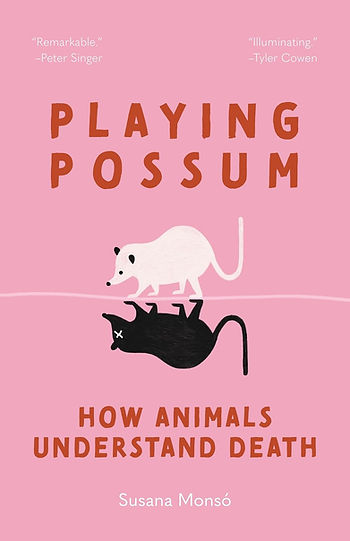
Not that I am a stranger to philosophy books. I’ve read several volumes each of Nietzsche, of Schopenhauer, of Kierkegaard, and of a host of other dead white European males. (No wonder I’m so messed up!) Even in translation, the poeticism of these aforementioned philosophers still shines through. While this author, Susana Monsó, occasionally writes with wit, her self-translated prose is hardly poetic. The attractive cover design and the catchy title (a la Mary Roach) lured me to buy the book, but only my stubborn perseverance led me to read most, admittedly not all, of it. I skimmed past many pages of academic jargon else I would have given up reading altogether.
The alluring chapter titles set the stage for the chapters to look like they will be poetic:
1 – The Silence of the Chimps
2 – The Ant Who Attended Her Funeral
3 – The Whale Who Carried Her Baby Across Half the World
4 – The Ape Who Played House with Corpses
5 – The Dog Who Mistook His Human for a Snack
6 – The Elephant Who Collected Ivory
7 – The Opossum Who Was Both Dead and Alive
8 – The Animal Who Brought Flowers to the Dead
The first page or two of each chapter then provides real-life examples of animal interactions with death. These are sure to reinforce the reader’s expectations for some interesting reading to follow. Alas, such potential does not reach fruition. The author wanders off and gets stuck in the mire of academic philosophical gobbledygook.
I suggest reading completely only Chapter 1 (the Introduction) and Chapter 8 (the Conclusion), as these are written “in plain English.” Skim (or skip!) the rest. Readers who share their homes and their lives with cats and dogs are sure to find Chapter 5 of great interest. In addition to the Intro and Conclusion, I found Chapter 7 the most interesting and informative, especially in the hardbound edition its pages 173-189 about predators and prey. For a predator, every meal is a brush with death. For the prey, death is always lurking just around the bend.
Some examples of predatory behavior documented in this chapter verge on blood lust. I must confess that, as a vegan since 1970 who adores all animals, both wild and domesticated, both predator and prey, in my backyard woods I harbor a deeper affection for the local deer and rabbits because, as strict herbivores, they share my own tastes. I call them the home team. The adversarial visiting team of bobcats, foxes, and coyotes are also welcomed. While they hunger for a yummy bunny, I hold no grudge against them.
Yet I was surprised to learn, for instance, that orcas (aka “killer” whales) play with their prey both dead and alive. Dolphins, too, exhibit the same deviant behavior. “These examples show that predators tend to very much enjoy the hunt, to the degree that on occasion they carry it out as an end in itself.” (pages 180-181) This supports my contention that affluent Westerner humans who engage in the blood sport of hunting, contrary to all their fancy rationalizations, have mindsets that are permeated with blood lust.
Insofar as Chapter 7 was so thought provoking, this book was certainly worth my reading. Just not the entire book.
( Reviewed by Mark Mathew Braunstein www.MarkBraunstein.Org )